SenDEC FS500 Tachometer
NOT AVAILABLE
See our TTO Tach's
|
Paramotoring Products:
PackagesMotors Wings Trikes Propellers Windsocks Tandem Bar Reserve Parachutes Accessories DVD's Books Used |
SenDEC Tachometer

Tachometer for Monitoring Engine RPM
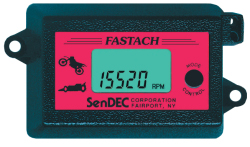 SenDEC's FS500 is a surface mountable Tachometer/Hour meter that features a resetable job timer in addition to a totalizing hour meter.
The tachometer is accurate to 16,000 rpms and features a resetable maximum RPM recall.
This multifunction meter is programable to three different firing patterns to accomodate two and four-stroke engines.
Programmable tachometer:
• P1 - 1 spark: 1 RPM... max 16,000 RPM
• P2 - 2 spark: 1 RPM... max 8,000 RPM
• P3 - 1 spark: 2 RPM... max 16,000 RPM
• Maximum RPM recall feature
• Maximum RPM clear feature
• Operating temperature: -40C to 71C
• LCD digit height: 0.200
• Dimensions: 2.8" W x 1.78" D x 0.69" H
• Weight: 0.130 lbs
• Tachometer resolution:
P1... 40 RPM
P2... 20 RPM
P3... 80 RPM
• Display update time: 1.5 seconds
Environmental Specifications:
- Operating temperature: -40F to 160F (-40C to 71C)
- Shock: SAE J1378 55g
- Vibration: SAE J1378 20g
- Humidity: SAE J1378 95% RH
- 100% Epoxy encapsulated
- Case Material: ABS, black or white
- Weight 1 oz
- Warranty: Two years for OEMs
- Waterproof to 70' below surface
- UL & CUL recognized, CE approved
Meter Operation:
Push and release mode control to toggle between Hour Meter, Tachometer, Job Timer, and Service Alarm (SVC TIME, SVC SET).
Hour Meter - Indicated by "TOT TIME" on display (non-resettable accumulated running hours.)
Tachometer - Upon entering this function, you will see "P1", "P2", or "P3" for 3 seconds on the right-hand side of the display. This is the current programmed firing pattern. To access MAXTACH (highest engine RPM), be in the RPM mode and hold the mode button down for at least three seconds. To erase the high RPM, continue holding down for at least 9 seconds (will see 0000). To change the firing pattern, be in the RPM mode and hold the mode button down for more than 10 seconds, then release the button on the desired firing pattern ("P1", "P2", or"P3").
Job Timer - To view the JOB TIME, push and release the mode button until the display reads "JOB TIME". To reset to zero, depress the mode button for three seconds (time will clear to 0.0)
Service Time - This is the time built up since your last maintenance. To view the Service Time, push and release the mode button until the display reads "SVC TIME". When this time exceeds what you set in SVC SET, the display will start flashing (alarming you to perform maintenance). After the maintenance is performed, hold down the mode button for 3 seconds. This will clear the SVC TIME to 0.0 and the alarm will stop flashing. You are now ready to go toward your next maintenance interval.
Service Set - This is where you set the desired maintenance interval. To view the set maintenance interval, push and release the mode button until the display reads "SVC SET". To set a different service interval, push and hold the mode button until the desired interval appears on the display. Then simply release the mode button and that is your new service interval. (The mode button must be held down for at least 3 seconds before the Service Set intervals begin to increment.
Installation of the Sendec Tachometers:
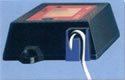 View of meter (cut away) with wire in U-shaped channel. |
 View of spark plug wire with pickup wire wrapped around 4 times. |